
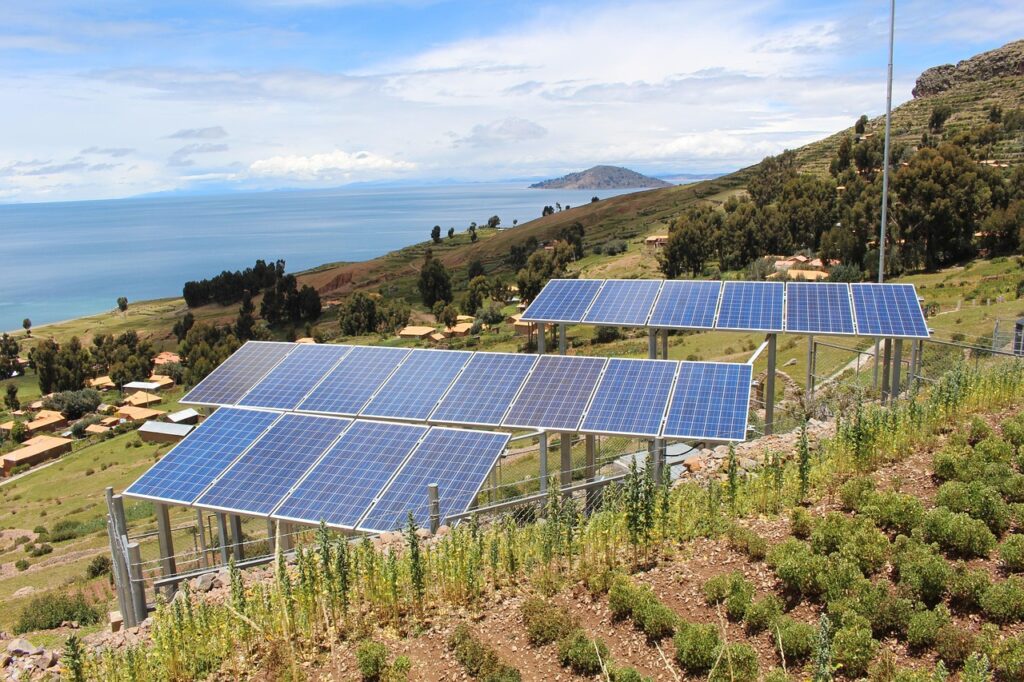
Solar energy presents certain challenges. The initial cost of equipment, transporting panels, maintenance, local training, and seasonal variability in sunlight are all real obstacles
Pourtant, la Suisse montre qu’il est possible de les surmonter. Ce pays parvient à produire de l’électricité solaire dans des régions montagneuses, au cœur des Alpes, malgré un climat changeant et des conditions parfois extrêmes.
Why solar energy remains a sustainable option for rural Africa despite everything
- The cost of panels is decreasing over time and supply chains are strengthening.
- There is no need to build large power plants or transport electricity over long distances.
- The climate emergency, population growth, and rising energy demand require resilient and renewable solutions.
- As in Switzerland, public subsidies, partnerships, and local commitment can make solar energy accessible, profitable, and sustainable in the long term.
Some key figures
According to the International Renewable Energy Agency (IRENA), the cost per kilowatt-peak (kW) for utility-scale solar installations has fallen sharply in Africa—from around US$3,437/kW in 2015 to US$1,093/kW in 2024.
Furthermore, in some East African countries, connecting a rural household via solar mini-grids costs between US$160 and US$700 per household, which is much less than extending the central grid to remote areas. These mini-grids also reduce transmission losses, which can reach 30 to 40% in centralized electricity systems.
Conclusion
The Swiss example teaches us that solar energy, even in difficult or inaccessible environments, can be viable, sustainable, and transformative.
For rural Africa, this is one of the best opportunities to bring electricity, improve quality of life, and build a more equitable future.
📚 References
International Renewable Energy Agency. (2024). Renewable Power Generation Costs in 2023. Abu Dhabi: IRENA. https://www.irena.org/publications
International Renewable Energy Agency & International Energy Agency. (2023). Renewables in Africa: Accelerating the Energy Transition. Abu Dhabi/Paris: IRENA/IEA.
Office fédéral de l’énergie (OFEN). (2024). Statistiques de l’énergie solaire en Suisse 2024. Berne: Département fédéral de l’environnement, des transports, de l’énergie et de la communication. https://www.bfe.admin.ch/
United Nations Development Programme & Sustainable Energy for All. (2023). Sustainable Energy for All Progress Report 2023. New York: UNDP. https://www.seforall.org/
World Bank, Energy Sector Management Assistance Program (ESMAP). (2023). Mini Grids for Half a Billion People: Market Outlook and Handbook for Decision Makers. Washington, DC: World Bank. https://esmap.org/